Zero-Shot Search: Search aerial imagery by meaning
Wikus Brink is a Director of ML Engineering at Nearmap, where he leads the Agentic AI team working across the company’s aerial imagery and property intelligence products. He now focuses on generative AI products and on designing workflows where agentic systems and human expertise complement each other.
Wikus Brink is a Director of ML Engineering at Nearmap, where he leads the Agentic AI team working across the company’s aerial imagery and property intelligence products. He now focuses on generative AI products and on designing workflows where agentic systems and human expertise complement each other.
What are embeddings?
A computer can understand an image, but not in the way you do. Your eyes take it in instantly. A computer has to work for it, spending real compute to process every pixel. Embeddings let a computer pay that cost once. A neural network generates a list of numbers representing the image, and that list is far cheaper and faster to work with than the raw image itself.
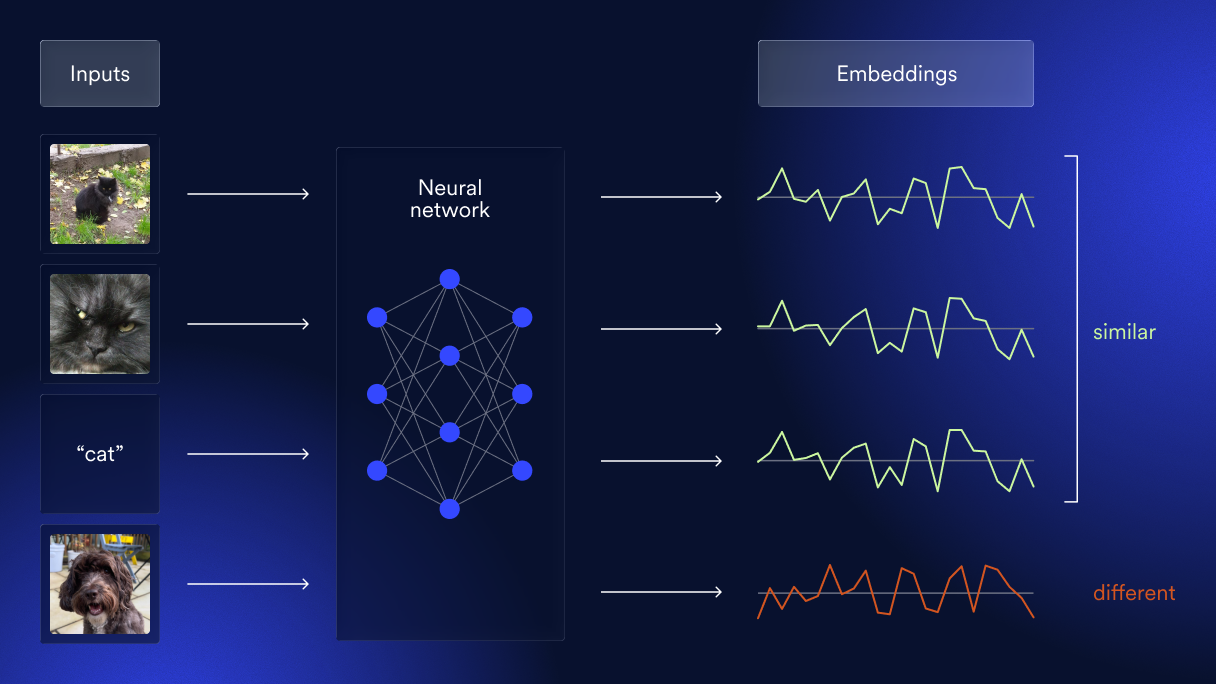
Every input, a photo or a phrase, comes out of the neural network as an embedding, drawn here as a line. The two cats and the word “cat” trace near-identical lines; the dog’s is clearly different. Lines are illustrative.
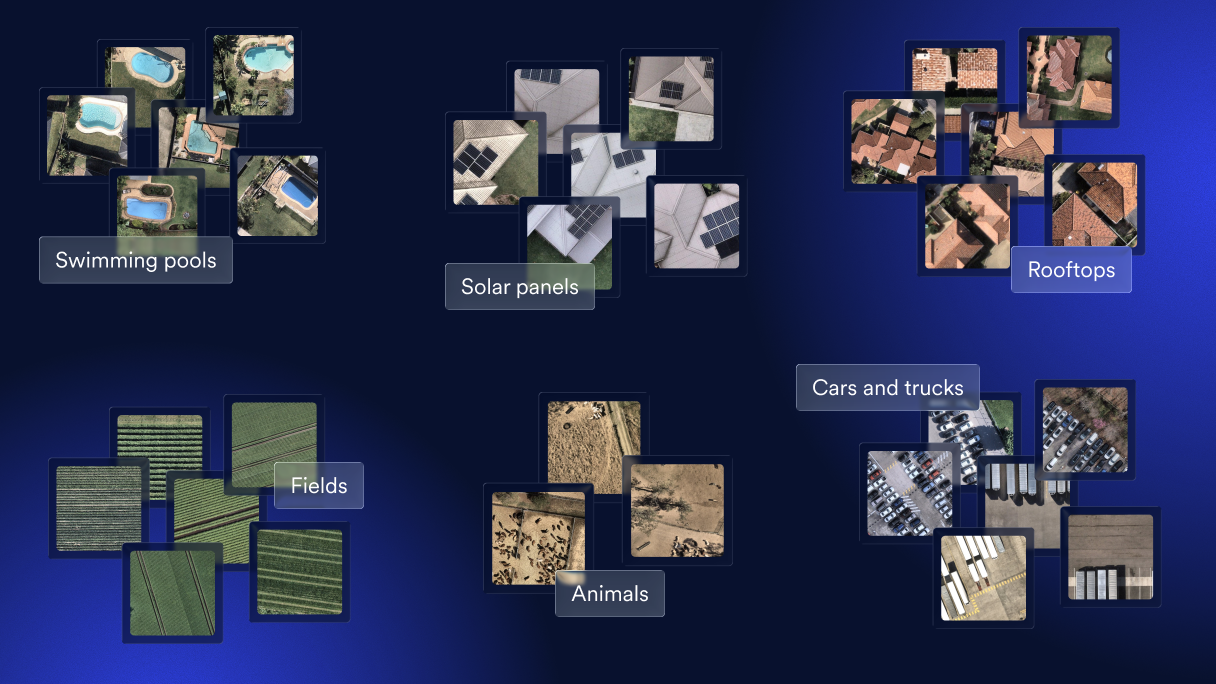
33 real Zero-Shot Search tiles, arranged so that tiles with similar embeddings sit close together. The clusters (pools, solar panels, fields, rooftops, cars, and more) form on their own.
The real breakthrough is that a photo and a phrase can share the same space. Training makes this possible. An underlying network analyzes millions of images paired with short text descriptions to learn how to place a picture near the words that describe it. We use a model from the SigLIP2 family, an open source set of models from Google that comes in several variants.
“Once words and images live in the same space, search gets simple. Drop a phrase in, and Zero-Shot Search finds what's nearby. Nobody has to teach the system that phrase in advance. That's what makes it zero-shot: any words work.”
Wikus Brink Director (ML Engineering) at NearmapTiles: Searching the archive
Zero-Shot Search embeds imagery ahead of time, not the moment you search. It cuts imagery into small square tiles — the same ones a web map loads as you pan and zoom — embeds each tile once, and stores it, making the images instantly searchable. This happens at six zoom levels, from a wide view down to fine detail, so the same location gets embedded at several scales.
Search three ways:
- Type a phrase. Zero-Shot Search embeds the words and returns the tiles with the closest embeddings.
- Give an example image. Zero-Shot Search embeds your image and pulls back the tiles that look most like it.
- Point to a spot on the map. Zero-Shot Search embeds the imagery there and finds other places that look similar.
Choose your search method and Zero-Shot Search will turn that query into an embedding, compare it against hundreds of millions of stored tile embeddings, and drop the closest matches onto the map in seconds. Zero-Shot Search is built to find imagery by meaning, not coordinates.
The top tile Zero-Shot Search returns for each text search, or the closest it can find for rare ones like “rainbow.”
Heatmaps
Search returns individual tiles that match your query. A heatmap answers a different question. Instead of finding specific matches, it scores an entire area at once. Give Zero-Shot Search an area and a phrase, and it shades the whole area based on how well each part matches. Warm colors mean a strong match. Cool colors mean a weak one. The result is a single image showing you both where something exists and where it clusters. Heatmaps are zero-shot, just like search, so the phrase can be anything.
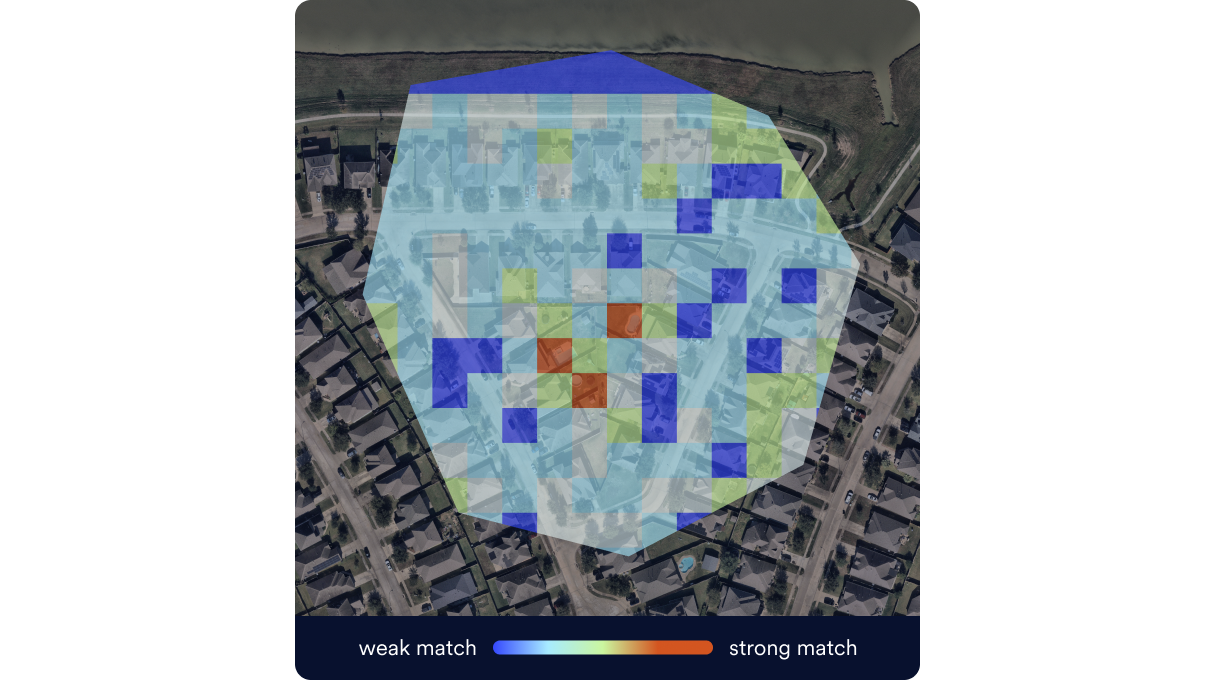
Every tile in the drawn area scored against “swimming pool” and shaded from cool to warm; the imagery outside the area is dimmed.
Properties: Many views of one place
Tiles and heatmaps both answer “where does this kind of scene show up?” But often what matters to you is a specific property. A property is more than a flat square. Nearmap captures from directly above (Vertical) and from several angles (Oblique, looking in from the north, south, east, west, and the corners). Properties get captured again and again as new surveys fly.
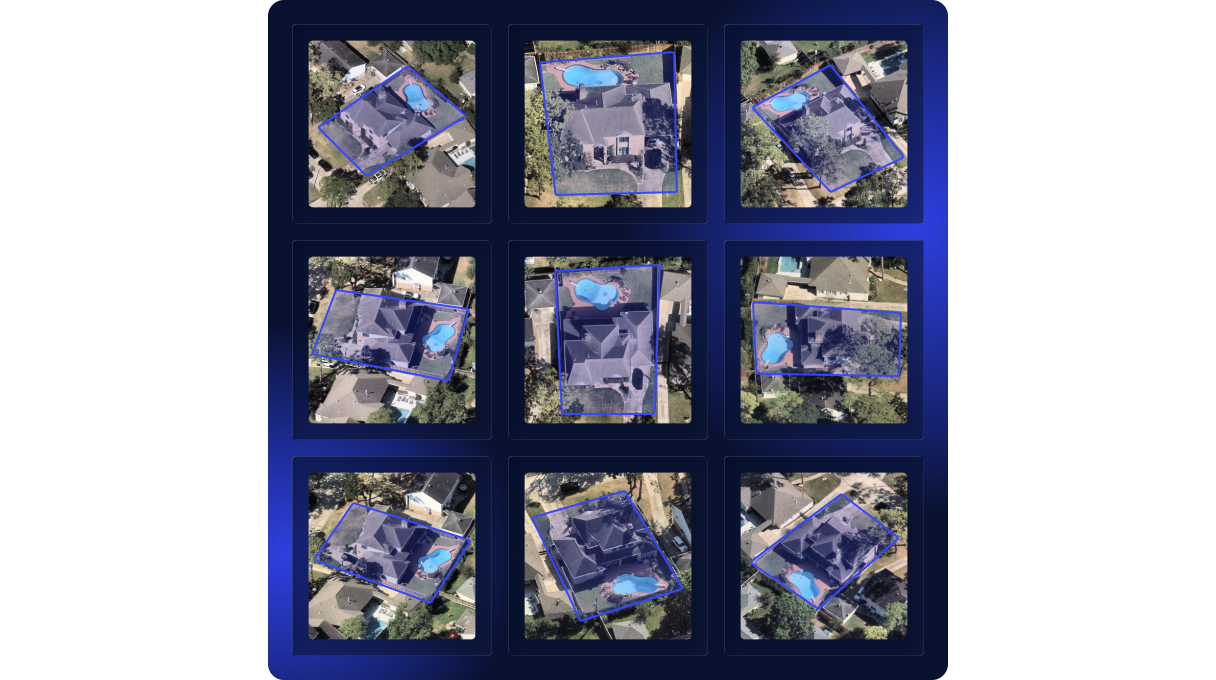
One property, seen from straight above (centre) and from eight Oblique directions around it. Zero-Shot Search bundles all these views of the same place together as a single property.
Oblique angles catch facade detail the Vertical view misses. Search Obliques directly, just as zero-shot as everything else. Simply name the feature you’re after, and Zero-Shot Search finds it. Here’s the top Oblique match for each search, with the matched property’s boundary drawn on:
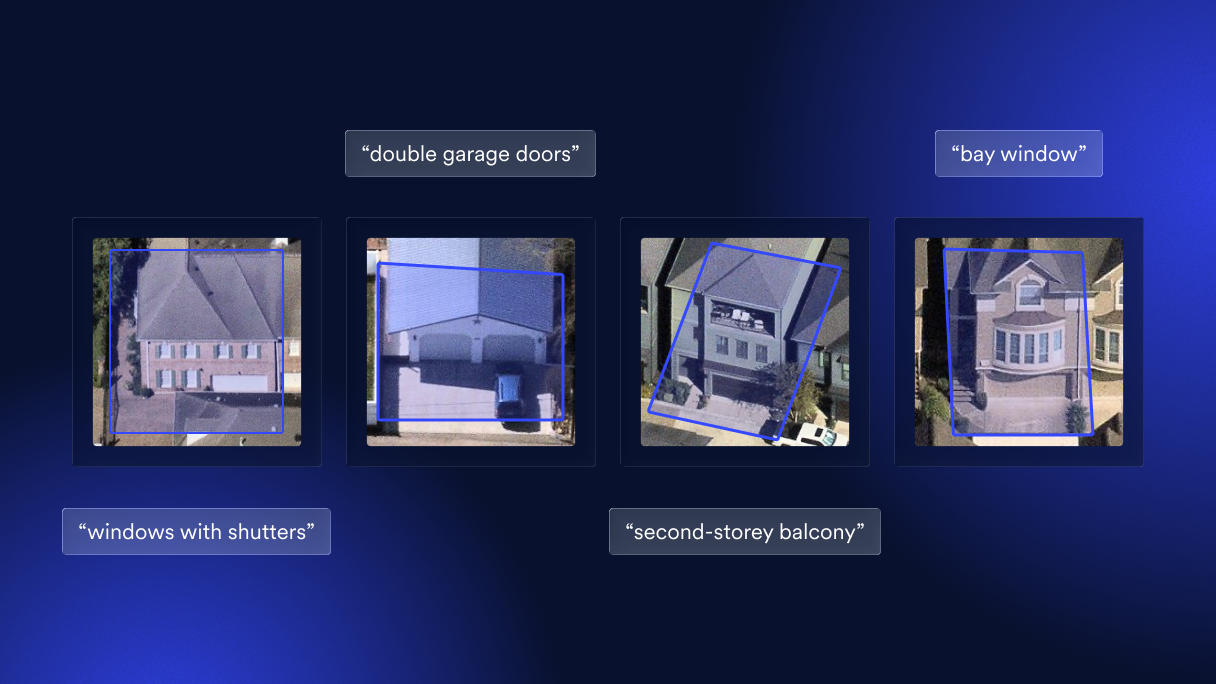
Top Oblique match for each search, with the matched property's boundary outlined.
“One idea powers all of this: turn imagery and the words that describe it into embeddings that sit in the same space. Once you have that, finding a tile, shading a neighborhood, and comparing a property across years all become the same question. No need to train anything. You just ask.”
Wikus Brink Director (ML Engineering) at NearmapDiscover more from Nearmap Labs
Curious what's next in property intelligence? Meet the team, follow the journey, and join the early access community.
Explore Labs