What Springfield Lakes revealed about disaster recovery
Analyzing the roofs that never truly recovered with AI data and property intelligence.
)
Halloween 2020 should have been about kids trick-or-treating, and arguments over whether we even need this American holiday in Australia. Instead, residents of Springfield Lakes spent it watching hailstones punch through ceilings and crash onto kitchen floors.
The suburb in South East Queensland copped what locals now call a “hail bomb.” Videos from that day show people standing in their homes in disbelief as ice tore through their roofs. Tennis-ball sized hailstones left 520 homes uninhabitable. More than 2,000 properties were damaged. The final tally: $1.05 billion in claims across 45,000 individual claims.
We’ve been capturing Springfield Lakes since 2009, when it was still being built. That gave us something rare when the storm hit: over a decade of baseline data, with continued regular captures since. We could watch exactly how a community recovers from catastrophic damage, measured not in insurance reports or anecdotes, but in actual, visible change over time.
It wasn’t the first major hailstorm to hit the suburb, and it wouldn’t be the last. What we found tells a story that standard claims data simply can’t capture.
The aftermath
Right after the storm, our AI picked up around 800 individual temporary repairs across the suburb. People weren’t just using blue tarps, though. Hardware stores ran out. So residents got creative with silver sheets, orange plastic, whatever they could find to keep the rain out. Our Roof with Temporary Repair AI layer caught all of it.
)
Nearmap AI detects property features
Building (Orange), Roof with Temporary Repair (Yellow), Med & High Vegetation (Green), and Water (Blue)
A few weeks later, that number actually went up. Not because there was more damage, but because people who initially couldn’t get materials finally managed to get something, anything, onto their roofs.
)
Six months later: major progress. Most repairs were done.
A year later: just nine temporary repairs remained.
On the surface, that looks like a recovery. Community bounces back, life goes on. Right?
Except it didn’t fully recover
We track something called the Roof Spotlight Index, or RSI. It’s a 0-100 scale where 100 is a pristine new roof and 0 is a disaster. Before the storm, even the worst 1% of roofs in Springfield Lakes were scoring around 95. The suburb was relatively new. Roofs were in good shape.
The hailstorm changed that instantly. Look at the percentiles over time. The 10th percentile—meaning the worst 10% of roofs—dropped to around 30. The main cause was the widespread extensive damage to roofs, with large holes where hail punched through and leaks hastily covered by tarps. When a large portion of the suburb was rendered virtually uninhabitable for a brief window, the score reflects that reality.
)
But even now, years later, those worst-performing roofs haven’t recovered to pre-storm levels. The trend line stays low and continues downward. The worst 1% of roofs are still sitting in the mid-70s, nowhere near where they started.
Why?
The repair vs. replace divide
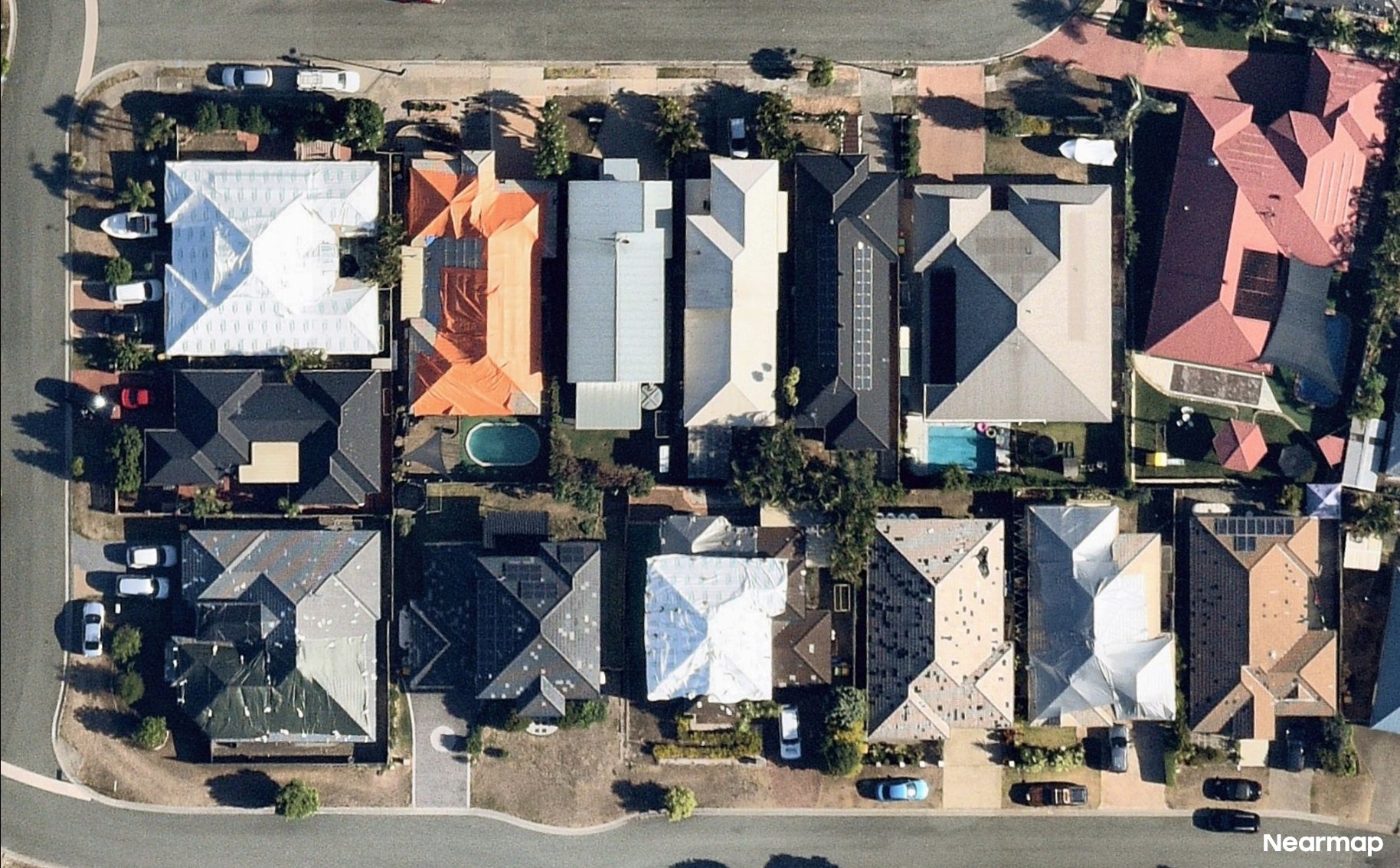
Looking at individual properties over time, a pattern emerged. Roofs that got completely replaced bounced back to high RSI scores. Roofs that got patched? They’re still showing wear. You can see it in the imagery: that patchwork appearance where some sections look newer than others.
One property we tracked had repairs done but you can still see the mismatched patching. The RSI stayed depressed. Meanwhile, neighbouring properties that got full replacements are scoring in the 90s again.
This matters for everyone involved. For homeowners, it’s about long-term property value and insurability. For insurers, it affects future underwriting and pricing decisions. For communities, it means some neighbourhoods carry visible scars from disasters longer than others. Those same patched roofs then face the next storm in a weaker state than before.
Even on the areas that weren’t visibly damaged, the aging can be dramatically accelerated, as the hail impacts wear away protective surface coatings, loosen mortar, and create gaps for leaks to enter. One of the most challenging problems for the insurance industry today is in deciding what level of damage is required to warrant a full replacement. Nearmap aerial imagery and AI can make this a much more data driven decision.
Metal won the fight
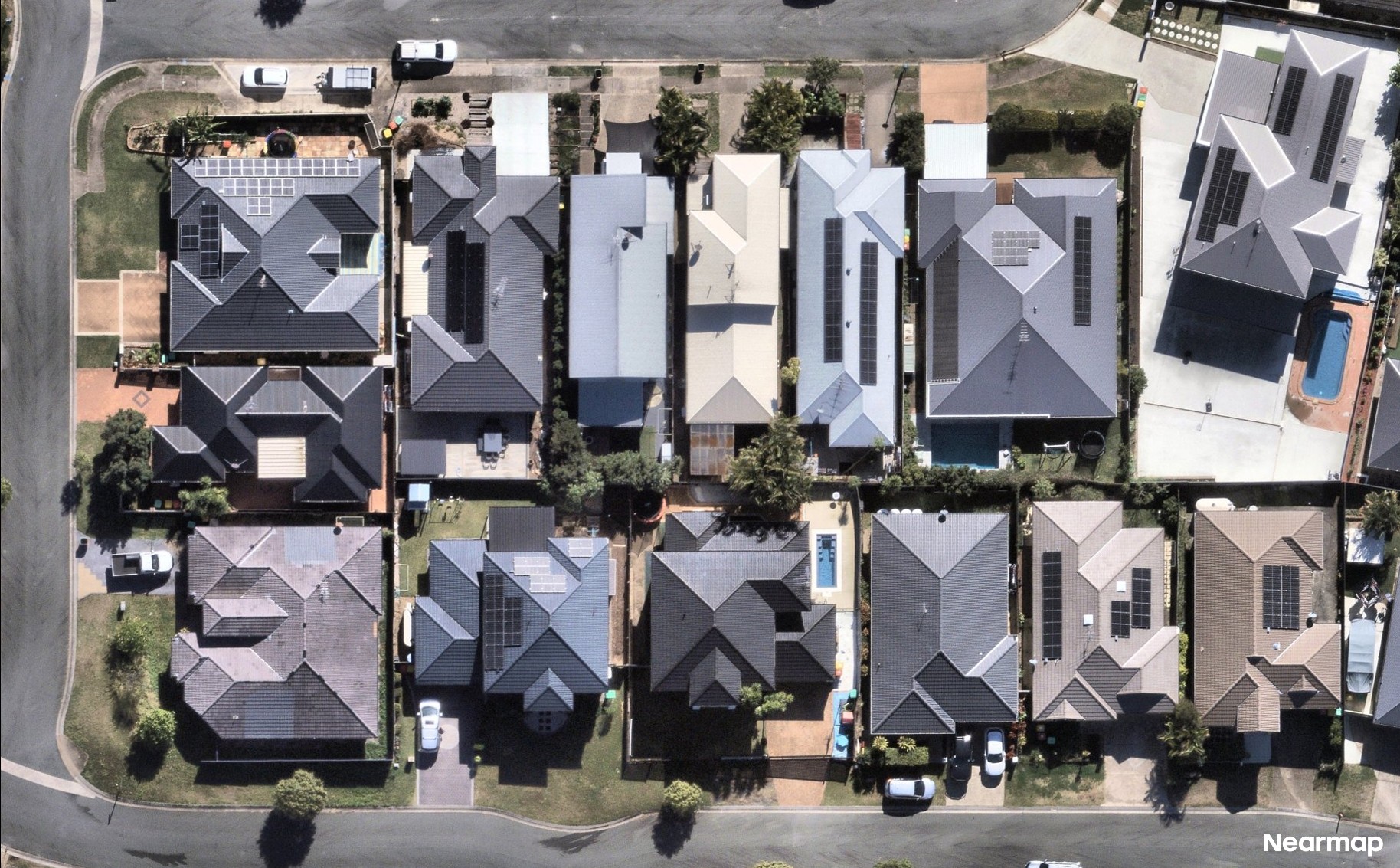
Before the storm, metal and tile roofs in Springfield Lakes had basically identical RSI scores—tracking together around the same levels. After the storm? Metal roofs barely budged. Tile roofs got hammered.
The numbers tell the story: immediately after the event, 12.4% of tiled roofs scored below 50 on the RSI. For metal roofs, the number was negligible.
Five years on, metal roofs in the suburb look virtually the same as they did before the storm, still scoring in the high 90s. Many tile roofs never recovered their pre-event scores, and you can still see the repairs and replacements in the data.
This isn’t about cheap tin sheds versus fancy tiles. This is quality metal roofing designed for homes versus traditional tile construction. When tennis-ball sized hailstones are falling from the sky, material choice matters.
)
When ‘closed’ doesn’t mean recovered
Of those 45,000 claims filed after the Springfield Lakes hailstorm, 93% are now closed. That sounds like success. The system worked, people got paid, repairs got done.
But “closed” doesn’t mean “fully recovered.” The data shows something different. Five years later, the physical evidence of that Halloween night is still visible—in roof scores that never quite made it back, in communities where some properties recovered completely while others are still marked by patched repairs.
The gap between administrative recovery and actual recovery matters. And now we can measure it.
A decade fighting the elements
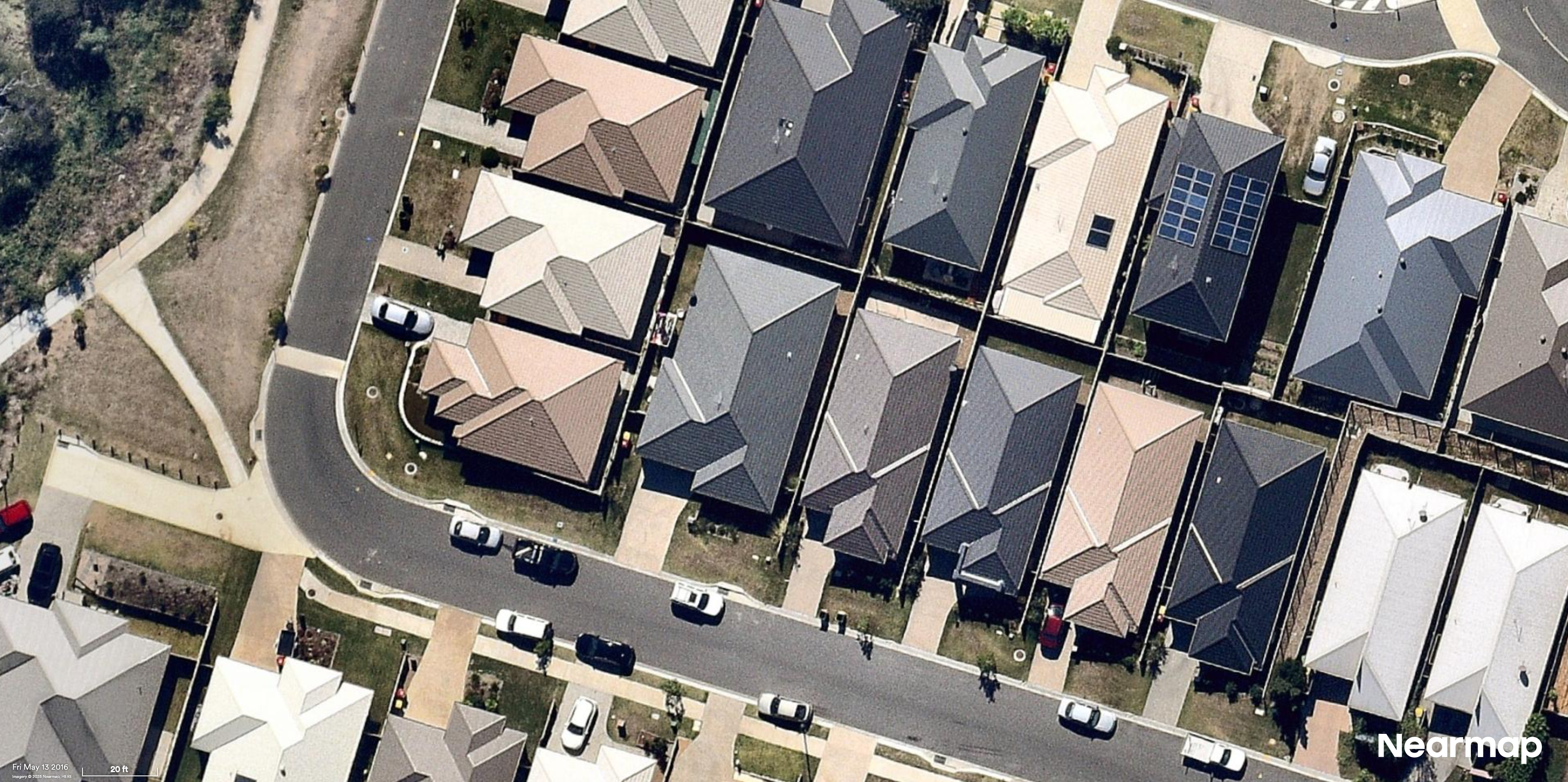
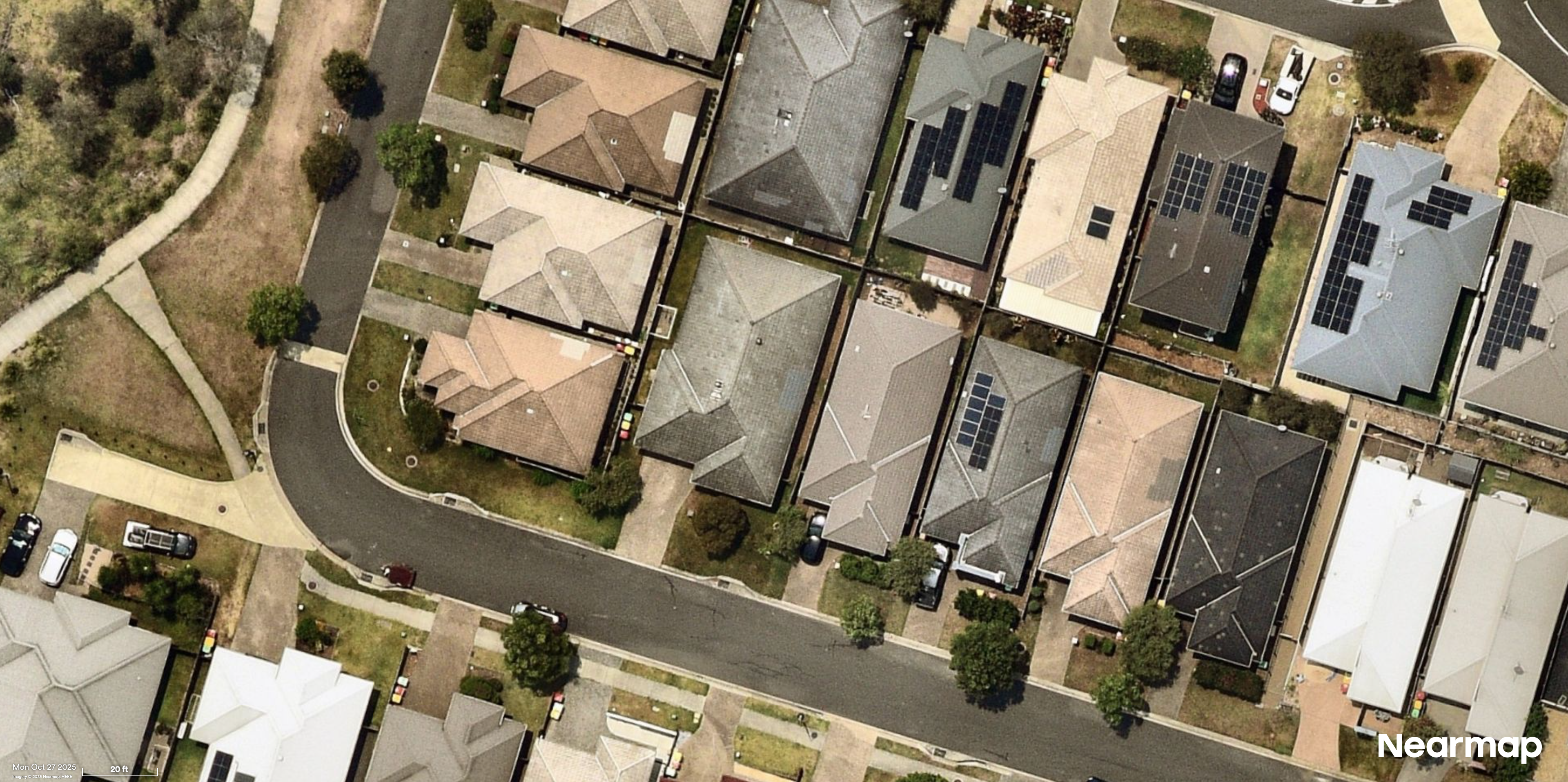
Pull up the aerial imagery from 2016 and you’re looking at pristine rooflines. Brand new developments, fresh tiles, clean gutters. These roofs were built to last decades.
Fast forward to 2025. Those same roofs tell a different story. You see staining. Patches of permanent repair work. Tiles that don’t quite match. The visual signature of a neighbourhood that’s weathered multiple storm seasons.
Since those homes were built, they’ve weathered multiple significant storm events. Each one leaves its mark, even when the damage doesn’t trigger a claim. The result: roofs that are aging faster than their years, carrying more risk than their age alone would suggest.
A new way to understand recovery
Springfield Lakes is one suburb. We cover over 7,000 suburbs in Australia and up to 87% of the U.S. population. Every single capture runs through the same AI system, detecting the same features, building the same kind of historical record.
What we learned in Springfield Lakes isn’t just about one hailstorm in Queensland. It’s a template for understanding disaster recovery anywhere. How long does it really take for a community to bounce back? Which interventions work? What are the long-term consequences of repair decisions made in the immediate aftermath?
The imagery is there. The AI-detected features are there. The historical comparisons are there. Now we can reason about disaster recovery in ways nobody could before.
Need a better way to track disaster recovery?
Bring your challenge to us and we’ll provide tailored advice for how you could use aerial imagery and actionable AI data to accurately track recovery and improve resilience.
)
About the author
Dr. Michael Bewley leads the Nearmap AI and Computer Vision group, turning large scale aerial imagery into visual and semantic products for customers in property insurance, local government, and more. Starting as the company’s first data scientist in 2017, Mike lead the first national scale beta launch and subsequent product iterations for Nearmap AI. He now focusses on building out the technology that will power future products, recently completing the technical integration of a recent acquisition in the Insuretech space into the Nearmap AI stack. Mike has experience in a range of high stakes and regulated industries, from medical devices at Cochlear to underwater robotics during his PhD at the ACFR.